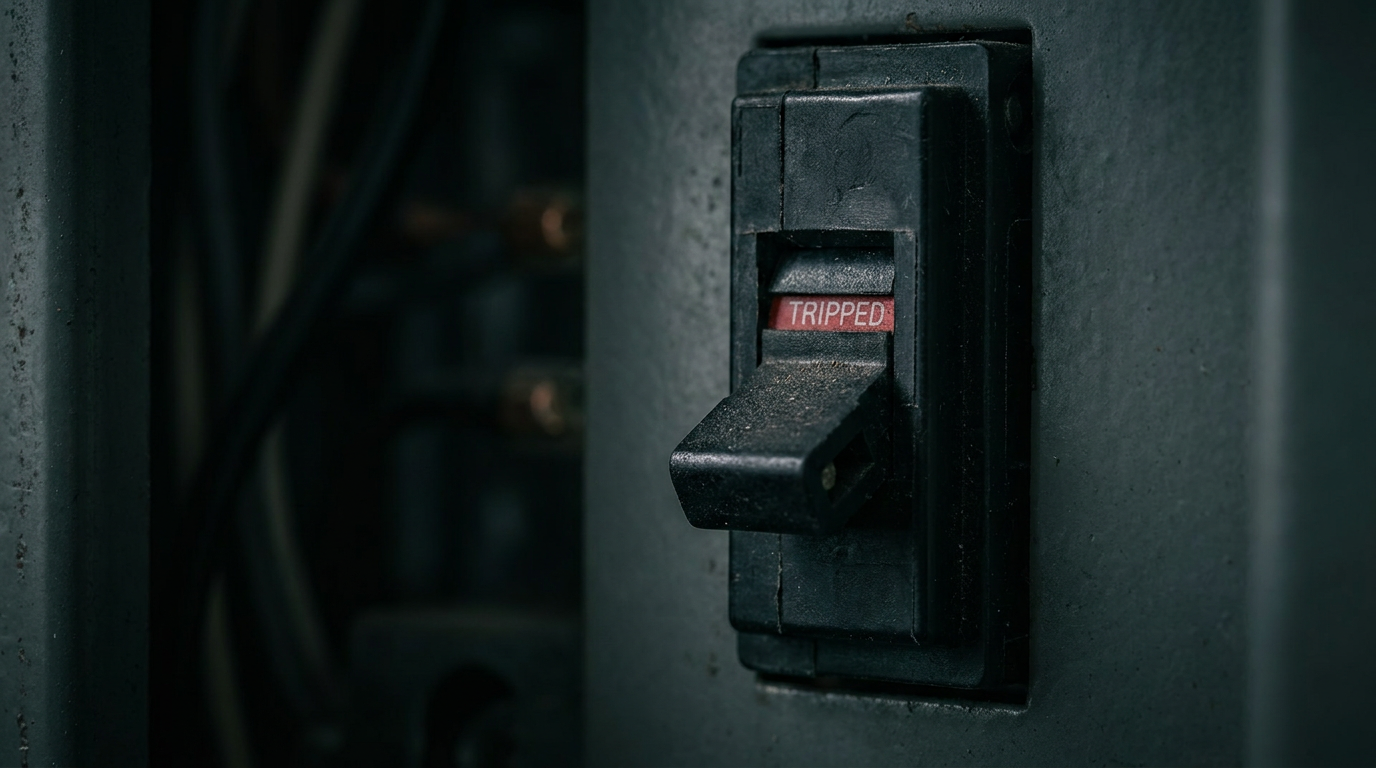
It usually happens at the worst possible moment. The fryer is loaded, two reach-ins are humming, the espresso machine is mid-shot, and then a section of the kitchen goes dark. Somebody walks to the panel, flips the breaker back on, and everyone gets back to work. By August, in a lot of Hampton Roads kitchens, that walk to the panel becomes a daily ritual. The trouble is that a breaker is not malfunctioning when it trips. It is doing exactly its job, and the trip is telling you something that resetting it will not fix.
A breaker exists to cut power before a circuit overheats and starts a fire. When it trips, one of a few things is happening, and they are worth knowing because the right response is different for each. The most common by far is a simple overload: more equipment is pulling current through one circuit than that circuit is rated to carry. The second is a short circuit or ground fault, where electricity finds a path it should never take, often through moisture or failed insulation. The third is a breaker or a piece of equipment that is simply wearing out. Flipping the switch back on treats none of these, it just resets the clock until the next trip.
Why summer makes it worse
Summer stacks the deck in several ways at once. Every compressor in the building, the walk-in, the reach-ins, the ice machine, the rooftop AC, runs longer and harder when the outdoor temperature climbs, so the steady current draw across your panel rises right when you can least afford it. A compressor that is low on refrigerant or sitting behind a dirty condenser coil works even harder and pulls even more amps, nudging a borderline circuit over the edge. On top of that, a breaker is a thermal device by design, so a panel baking in a hot back room or an unconditioned utility closet will trip at a lower load than the same breaker would in winter. None of that is a coincidence, it is the season doing exactly what it does to electrical systems here.
The ground fault you should never ignore
There is one pattern that deserves real respect. If a breaker, especially a GFCI breaker near a sink, prep station, or dish area, trips the instant a specific machine switches on, that is rarely an overload. It usually means current is leaking to ground inside that equipment, often through a failing heating element, a cracked wire, or moisture that has worked into a connection. Commercial kitchens are required to have GFCI protection around water for exactly this reason, and a GFCI does its job by sensing tiny amounts of leakage that a standard breaker would miss. That sensitivity is a feature, not a nuisance, because the same leak it catches is a genuine shock hazard to your staff. When a single machine trips its breaker every time it energizes, take that machine out of service and have it looked at rather than forcing the circuit back on.
What resetting it over and over actually costs
Repeatedly resetting a breaker that keeps tripping is not a neutral act. Every trip and reset cycle stresses the breaker contacts, and a breaker that has tripped hundreds of times can weaken to the point that it no longer trips when it should, which is the failure mode that actually starts fires. You may also be cooking the very equipment you are trying to keep running, since motors and compressors that brown out and restart repeatedly do not last. And there is a hidden tax in your utility bill, because equipment fighting an undersized or compromised circuit runs inefficiently the whole time. The breaker that trips twice a week is not saving you a service call, it is quietly raising the bill for a bigger one.
When to stop flipping and make the call
A reasonable rule for an operator: reset a breaker once. If it holds, keep an eye on it. If it trips again the same day, or if it trips the moment a particular machine turns on, stop and get it diagnosed. The fix is usually one of a handful of things, none of which you want to guess at: a high-draw machine that needs its own dedicated circuit, a failing capacitor or compressor pulling excess amps, a worn breaker that needs replacing, or a ground fault inside a specific appliance. Sorting out which one it is takes a meter and a few minutes from someone who works on this equipment, and it is far cheaper than the dark Friday night that a neglected panel eventually delivers. KitchenGuard handles the equipment side of these calls, the compressors, the controls, the connections, and works within Virginia minor electrical repair limits, bringing in a licensed electrician for panel and circuit work when that is what the situation calls for.
If a breaker in your kitchen keeps tripping, do not keep resetting it and hoping. Let us find out what is actually pulling it down before it takes a compressor, or your busiest night, with it.
Call us at (757) 304-0029 or email [email protected] and we will get someone out to your kitchen.