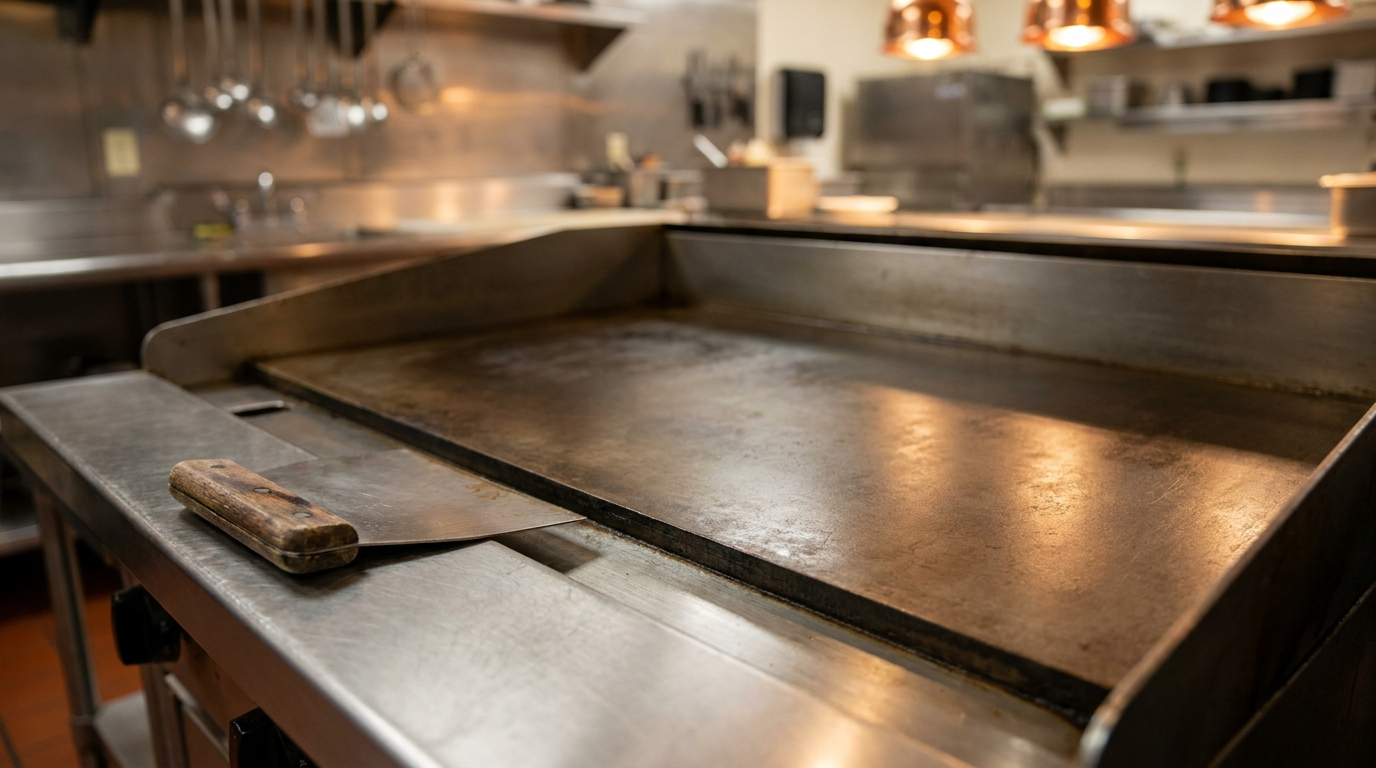
The flat-top griddle is one of the most heavily used pieces of equipment in a commercial kitchen, and one of the most neglected when it comes to real maintenance. Most operators wipe it down between shifts, which is the right start, but the routine stops there. Carbon buildup on the cooking surface, failing thermostats that create hot and cold zones, and clogged grease troughs that become a fire risk all develop quietly over weeks of regular service. By the time you notice a problem, the damage to food quality or to the equipment itself is already done. A simple layered routine, daily, weekly, and professional, prevents most of what we see in the field.
Daily care begins at the end of every shift. While the griddle is still warm (not scorching hot), scrape the entire surface with a flat griddle scraper, working toward the grease trough in long, even strokes. Scraping while the surface is warm lifts residue before it hardens into carbon; trying to remove it the next morning when it is cold and set takes three times the effort and leaves behind more than you think. After scraping, apply a thin coat of high-smoke-point cooking oil across the surface and wipe it down. This keeps the steel seasoned and prevents rust in overnight humidity, which Hampton Roads kitchens deal with more than most. Finally, clean the grease trough and catch cup completely. A trough that overflows or sits with collected grease does not just smell bad; it is a direct path to a grease fire under the hood.
The weekly deep clean matters more than most owners realize
Once a week the griddle needs more than a scrape and wipe. A proper weekly cleaning uses a commercial-grade griddle cleaning block or a flat stone along with an appropriate griddle cleaner to work out the carbon and polymerized grease that daily scraping does not reach. Work in sections, apply the cleaner according to the manufacturer's instructions, and scrub with the grain of the steel. Rinse thoroughly so no cleaning chemical remains, then re-season the entire surface with a fresh oil coat. Pay attention to the back rail and the area near the grease trough, where buildup concentrates. While you are at it, pull the grease drawer and wash it, wipe down the sides and front of the unit, and check the legs and any under-shelf for grease accumulation. Grease that drips off the unit onto the floor or into the equipment base has a way of finding ignition sources you did not account for.
Temperature accuracy is a cooking and safety issue
A griddle that reads 350 degrees on the dial but delivers 290 degrees in one zone and 420 degrees in another is a problem most kitchens adapt to rather than fix. Cooks learn which corner to use for what, food quality varies, and tickets slow down. What they are usually adapting around is a thermostat or temperature probe that has drifted, one or more heating elements or burners that are worn or partially blocked, or uneven heat distribution from carbon buildup that has insulated part of the cooking surface. Verifying griddle temperature with an accurate infrared thermometer across multiple zones takes about two minutes and tells you immediately whether what the dial says matches what the steel is doing. If zones are off by more than 25 degrees, that is a calibration job. If they are off by 50 degrees or more, there is likely a failing component behind it.
What to expect from a professional service visit
A technician visit on a commercial griddle covers the checks your crew cannot safely do themselves. On a gas unit, that means inspecting the burner ports and orifices for clogs that create uneven flame, checking the pilot assembly or igniter, verifying gas pressure at the manifold, and testing the thermostat against a calibrated probe to document where it is running relative to setpoint. On electric units, it means testing element resistance, checking contactors for wear, and verifying the thermostat and temperature-limit controls. We also inspect the gas hose and connection on gas units for wear and proper seating, something that matters in a busy kitchen where equipment gets pushed and pulled regularly. For most griddles in a moderate-volume kitchen, once a year is a reasonable professional service interval. High-volume operations running the griddle all day should consider twice a year. It is a small cost against the alternative of a thermostat that has drifted far enough to burn an order or, worse, overheat the surface to the point where grease in the trough ignites.
A well-maintained griddle cooks faster, holds temperature accurately, and uses fuel or electricity efficiently. More importantly, it does not create the kind of uncontrolled heat events that commercial kitchens cannot afford. The daily and weekly routine is straightforward enough to build into the closing checklist and the weekly kitchen deep-clean, and it takes far less time than pulling a griddle that has cooked itself into a service call at noon on a Saturday. Put the professional visit on the calendar now, before the summer push is over, so it actually happens.
If your griddle is cooking unevenly, burning food in one zone, or has not had a professional calibration check in the last year, KitchenGuard can get it diagnosed and back in spec. We service all commercial cooking equipment in Virginia Beach, Norfolk, Chesapeake, and Portsmouth.
Call us at (757) 304-0029 or email [email protected] to schedule a service visit.